
Qantas Project Sunrise: The World’s Longest Nonstop Flight
- Happyfares

- Jul 29, 2025
- 4 min read
Updated: Oct 30, 2025
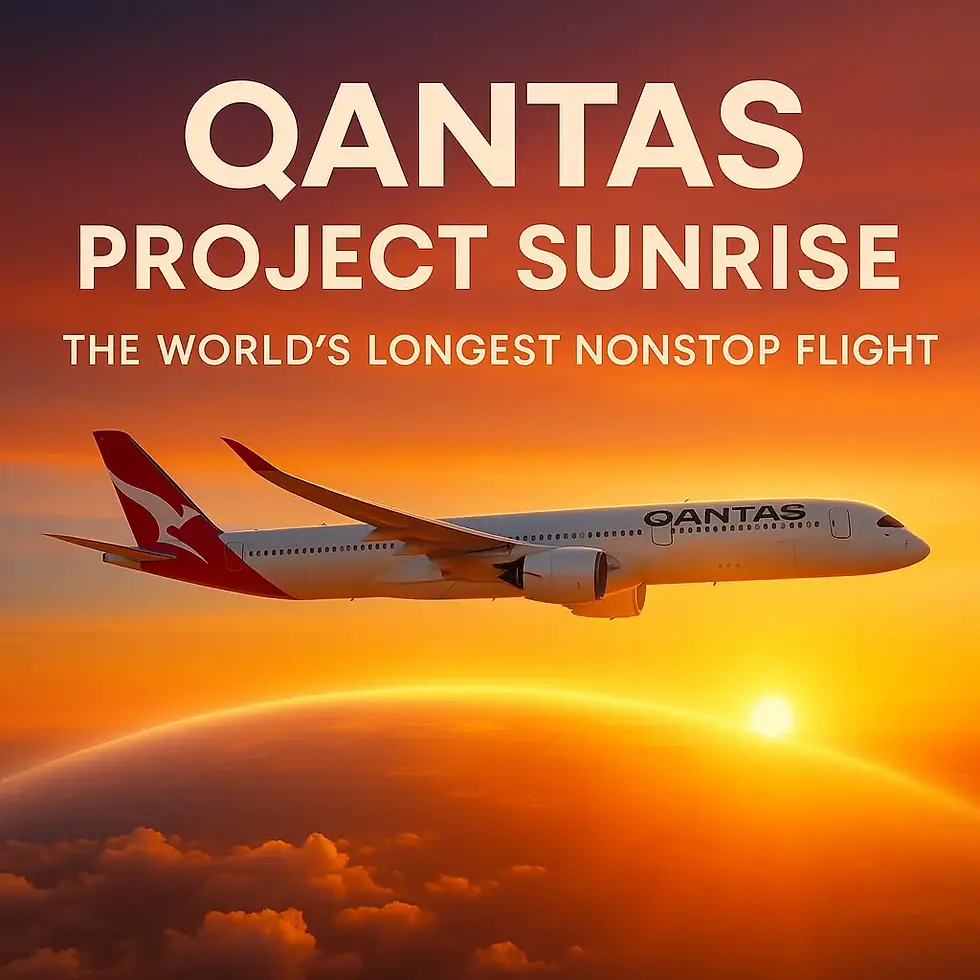
Artist’s impression of Qantas’ Airbus A350-1000 for Project Sunrise, which will fly non-stop between Australia and far-flung destinations.
Project Sunrise is Qantas Airways’ plan to launch the world’s longest nonstop passenger flight – a marathon journey from Sydney to London covering about 17,000 km in just over 20 hours. Slated to begin service in 2027, this historic route will surpass Singapore Airlines’ current Singapore–New York flight in both distance and duration.
Qantas has called direct Australia-to-Europe/US flights the “final frontier of aviation,” a vision first announced in 2017 to “revolutionise Australian air travel”. By eliminating stopovers, Project Sunrise can cut travel times by up to 4 hours compared to one-stop routes – truly shrinking the world and making aviation history.
The Aircraft & Ultra-Long-Haul Innovations
To conquer this ultra-long-haul feat, Qantas chose the Airbus A350-1000 as the dedicated Project Sunrise aircraft. A special A350-1000ULR (Ultra Long Range) variant is being developed with an extra fuel tank and other engineering tweaks to fly up to 21 hours nonstop.
Qantas placed an order for 12 of these A350-1000 jets in May 2022, each with a very low-density layout of just 238 seats (the fewest seats on any A350-1000 to date). For context, most A350-1000s seat 300+ passengers, but Qantas is sacrificing capacity to give travelers more room and comfort on these 20-hour flights.
Crucially, the cabin design is focused on wellness for the marathon journey. Over 40% of the seats will be premium cabins (First, Business, Premium Economy), and even Economy seats are more spacious than usual with a 33-inch pitch and ergonomically designed cushioning.
All passengers will have access to an onboard “Wellbeing Zone” – a dedicated space in the middle of the aircraft where travellers can stand, stretch, and hydrate during the flight. Qantas’ A350 onboard Wellbeing Zone will let passengers stretch their legs, do light exercises, and enjoy refreshments to stay fresh on the 20-hour journey.
In this zone (a world-first in commercial aviation), Qantas plans to provide guided exercise videos on screens, stretch bars, and self-serve snack/drink stations to help combat fatigue. The cabin will also feature custom lighting designed with scientific input to reduce jetlag – using dynamic LED lighting to help passengers adjust their circadian rhythm on these ultra-long sectors.
In terms of amenities, Qantas is pulling out all the stops. The A350 will have six First Class suites described as “mini hotel rooms” – each with a separate bed and recliner lounge chair, personal wardrobe, and a large entertainment screen.
The 52 Business Class suites will offer lie-flat beds and sliding privacy doors for a private mini-cabin experience. Even Premium Economy (40 seats) and Economy (140 seats) cabins are upgraded for comfort, featuring extra legroom, footrests/calf-support and larger seat-back screens.
Every passenger will enjoy free high-speed Wi-Fi (via next-gen satellites) and Bluetooth connectivity for their devices, a first for Qantas long-haul flights.
In short, these A350s are being custom-built for endurance flying, balancing efficiency with passenger well-being on flights where people will eat, sleep, and even exercise onboard.
Timeline, Launch Routes & Challenges
When will it launch? Qantas now plans to start Project Sunrise flights in late 2026 or early 2027, with the inaugural routes being Sydney–London and Sydney–New York. The first A350-1000 is scheduled to arrive in Australia by mid-2026 for testing and crew training, after which the Sydney-London route (dubbed the “Kangaroo Route” in its nonstop version) is expected to debut commercially.
Subsequent plans include Melbourne–London and New York, and potentially other long-haul city pairs like Paris, Frankfurt, Cape Town, and Rio de Janeiro directly from Australia. In fact, these A350s will also take over Qantas’s existing long flights (like Perth–London non-stop flight) to extend the same service standard across the network.
Project Sunrise’s timeline has faced setbacks. Originally, Qantas hoped to launch the service by 2023 – they even operated experimental 19+ hour test flights in 2019 using Boeing 787s with limited passengers to study crew and passenger health.
However, COVID-19 grounded international travel and forced Qantas to shelve the plan temporarily. The project was revived in 2022 with the aircraft order, but aircraft production and certification delays at Airbus have further pushed the schedule.
The first delivery, initially expected in late 2025, slipped by about six months to mid-2026. Despite these delays, Qantas remains confident in the timeline, noting that once the first jet is delivered, the rest of the A350 fleet will follow in quick succession. This means we can expect the first commercial Sunrise flights in 2027, marking the culmination of a decade-long quest.
Why Project Sunrise Is Historic 🔑
Project Sunrise isn’t just another new route – it’s a milestone in aviation history. For decades, a non-stop flight from the UK to Australia was considered the “holy grail” of long-haul aviation.
The distance is so vast that it was long beyond the range of commercial airliners. (Historically, Qantas’ famous 1940s “Double Sunrise” flights during WWII took over 30 hours with stops, and even the jet age required multiple refueling stops between London and Sydney.)
Achieving it now with modern aircraft is a testament to how far aviation technology and flight operations have advanced. This will be the world’s longest commercial flight by both distance and duration.
Travelers will experience two sunrises in one journey as the plane races the day-night terminator line across the globe. It’s a unique spectacle that underscores just how marathon-like this flight is.
From an industry perspective, Qantas is setting a new bar for ultra-long-haul service: airlines will be watching to see if passengers embrace spending 20 hours aloft and how the promised health and comfort innovations pan out.
If successful, Project Sunrise could reshape global travel, making far-flung city pairs viable and more convenient. It also signals confidence in air travel’s rebound – Qantas is investing heavily (around US$4.4 billion list price for 12 A350s) to pull off these flights, betting that passengers will pay a premium to save time and fly more comfortably nonstop.
In summary, Project Sunrise is significant not only because of its record-breaking stats, but because it represents ambition and innovation in aviation. Qantas had to challenge aircraft manufacturers to extend aircraft capabilities for range and efficiency.
The result is an airplane and in-flight service tailored for endurance, something we’ve never seen at this scale. If all goes to plan, 2027 will see Sydney and London connected by a continuous 20-hour flight, a dream many thought impossible – until Qantas proved otherwise. ✈️🌏


Comments